Podiumsdiskussionen
Vergangene Termine
-
 Wie weiter nach den Parlamentswahlen in Spanien?
Die Podiumsdiskussion findet auf Deutsch und Englisch mit Simultanübersetzung statt.
Nach den jüngsten Wahlen in Spanien zeichnete sich eine Pattsituation ab, in der weder die PP- noch PSOE-geführte Wunschkoalition eine Mehrheit hinter sich vereinen konnte. Zum plötzlichen Königsmacher in den Gesprächen um die Regierungsbildung avancierten die katalanischen Nationalisten von links und rechts, die letztlich die Wiederwahl von Pedro Sánchez als Ministerpräsident im Gegenzug für ein umstrittene Amnestie für katalanische Unabhängigkeitsvertreter ermöglichten.
-
 Widersprüche der Erinnerungskultur. Die Realität der postmigrantischen Gesellschaft anerkennen?
Die deutsche Gesellschaft ist stark von Migrationsbewegungen und dadurch von einer Vielstimmigkeit an Vergangenheits- und Erinnerungsnarrativen geprägt und die hier lebenden Menschen stützen ihre Identitäten auf unterschiedliche kulturelle Praktiken des Erinnerns. Das sog. Kollektive Gedächtnis einer ganzen Gesellschaft ist also von jeher ein von Widersprüchen gekennzeichnetes Konstrukt, das zwar den Anschein einer kohärenten Entwicklung, ähnlich einer Biografie, zu erwecken versucht, diesem aber nie wirklich gerecht werden kann. Daher muss, um Widersprüche und die daraus eventuell resultierende Konflikt so gering wie möglich zu halten, der Inhalt eines jeden kollektiven Gedächtnisses gruppiert, sortiert und priorisiert werden.
Eine dieser in Deutschland omnipräsenten Widerspruchskonstellationen ist die Erinnerung an die Shoah, die zwischen ritualisierten „Nie Wieder“ und der Forderung nach einem „Schlussstrich“ und zwischen Aushandlungen von Schuld und Versöhnung zwar immer wieder als Musterbeispiel der Aufarbeitung genannt, aber auch mindestens genauso oft kritisiert wird.
So erklärte der Publizist und Lyriker Max Czollek die deutsche Erinnerungskultur kürzlich zu einem „Versöhnungstheater“, das zwei Rollen vorsieht: Die Täter*innen, denen vergeben wird und die Opfer, die zu vergeben haben. Die Realität der postmigrantischen Gesellschaft bringt dieses einstudierte deutsche Schauspiel jedoch durcheinander, denn längst umfasst die Gesellschaft vielschichtige Perspektiven und Biographien, die sich nicht in dieses dichotome Feld einsortieren lassen. Daher wollen wir bei dieser Veranstaltung darüber sprechen, inwiefern das Versöhnungstheater darauf abzielt, die Widersprüche der postnazisitischen Gesellschaft aufzulösen und gleichzeitig an der Realität der postmigrantischen Gesellschaft scheitert. Was das für die deutsche Erinnerungskultur in der Praxis bedeutet und welche Herausforderungen aber auch Chancen das mit sich bringt, das wollen wir diskutieren.
-
 Constitution and/or Declaration. Discussing the Question of the (Linguistic) Construction of Contradictions
In this Lunchbox we want to discuss what it means to consider contradictions a product of declaration. In order to make clear the history and theoretical assumption of this concept, we want to give a brief input on Speech Act Theory and provide some concrete […]
-
 Afrospanish Literature. Between Activism and Creating References
Im Rahmen des 3. Wuppertaler Malala Day 2023.
-
Blackness as a Universal Claim. Holocaust Heritage, Noncitizen Futures and Black Power in Berlin
Damani Partridge from U Michigan discusses his new book Blackness as a Universal Claim. Holocaust Heritage, Noncitizen Furtures and Black Power in Berlin with Rozena Maart (U KwaZulu-Natal) and Lewis R. Gordon (UCON), moderated by Katrin Antweiler (IfEK/WoC, U Bremen).
-
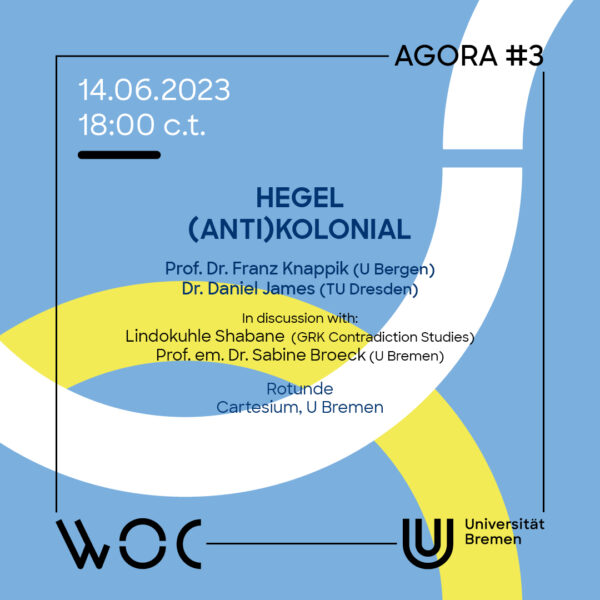 Hegel (anti)kolonial
Hegel arguably developed and disseminated racist and pro-colonialist views. At the same time, he has been a source of inspiration for generations of progressive philosophers, incl. thinkers in the Black radical tradition and their accounts of liberation. „Hegel(anti)kolonial“ is a project that aims to examine this ambivalent colonial legacy, both by discussing Hegel’s own texts and thought and by exploring issues of race and colonialism in traditions of post-Hegelian thought. In this talk, we exemplify this approach by focusing on one key instance, the topic of transatlantic slavery. In lectures and publications during his Berlin period, Hegel provides a series of comments on transatlantic slavery that we discuss in the first part of our talk. Constructing the debate on the abolition of slavery as an ‚antinomy‘ between anti- and pro-slavery views, he argues that slavery ultimately has to be overcome, but he also holds that as a tool for ‚disciplining‘ people of African descent (who, on his degrading account, lack the mental preconditions for a life in freedom) slavery is provisionally legitimate, and should not be abolished immediately. Hegel’s partial defense of slavery draws on his famous ‚master-slave‘ dialectic, which later would become a point of reference for various authors in the Black radical tradition. Among them, the second part of our talk singles out Angela Davis, who discusses the master-slave dialectic in her 1970 Lectures on Liberation, through the lens of Frederick Douglass’s account of his liberation. As we will show, Davis separates the ‚master-slave‘ dialectic from its apologetic context and drops the racialist background assumptions that supported Hegel’s partial defense of slavery. Instead, she emphasises the role of struggle (as opposed to ‚discipline‘) in liberating the enslaved. Davis, too, conceptualizes these issues in terms of a contradiction, but she locates it elsewhere than Hegel with his ‚antinomy‘ of slavery − namely, in the ‚paradox‘ of bourgeois philosophy that claims freedom for all humans, while de facto denying it to many.
-
 (Breaking) Barriers in Academia: Mapping the Field
The dominant understanding of academia assumes that beneficial participation for all involved (students, early career researchers, academic staff…) is based primarily on the ability to make a valuable intellectual contribution to research. In reality, however, universities – and higher education as a whole – are complex social systems in which the agency and access of each individual is determined in multiple ways, including by gender, ethnicity, social class, and health status. These determinations can create powerful cultural and social barriers and inequalities. In the panel discussion „(Breaking) Barriers in Science: Mapping the Field,“ we will try to overcome the taboo of not addressing them, identify the most common types of barriers, consider strategies for addressing them, and narrow down the future content of our Navigating Academia series.v
-
 Im Rückblick: Die Flucht über die Prager Botschaft 1989
Podium zur Diskussion über die Erinnerung an die Ereignisse im Herbst 1989 in der deutschen Botschaft in Prag, im Rahmen des Theaterstückes „Über den Zaun“.
-
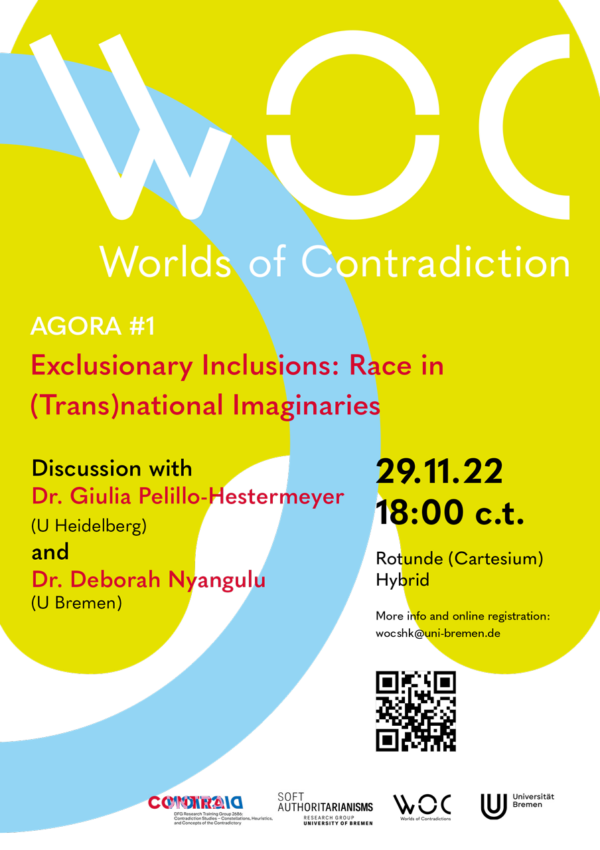 Exclusionary Inclusions: Race in (Trans)national Imaginaries
The first discussion in WoC’s new Agora format will focus on the exclusionary effects of contemporary discourses and politics of inclusion. Taking the globalization and mediatization of the Black Lives Matter movement as a starting point, the event will discuss transcultural negotiations of anti-racism against the backdrop of different colonial histories.