Publications
-
 Natalja Gorbanewskaja. Graphic Novel
“She was a poet as great as Joseph Brodsky and a human rights activist as fearless as Andrei Sakharov. Unlike Brodsky, however, she did not receive the Nobel Prize for Literature, and unlike Sakharov, she did not receive the Nobel Peace Prize. However, her name is associated with a unique event in the Soviet Union: On August 25, 1968, she and seven other young people came to Red Square to demonstrate openly against the regime – and against the suppression of the Prague Spring by tanks from the Soviet Union and other Warsaw Pact countries.”
-
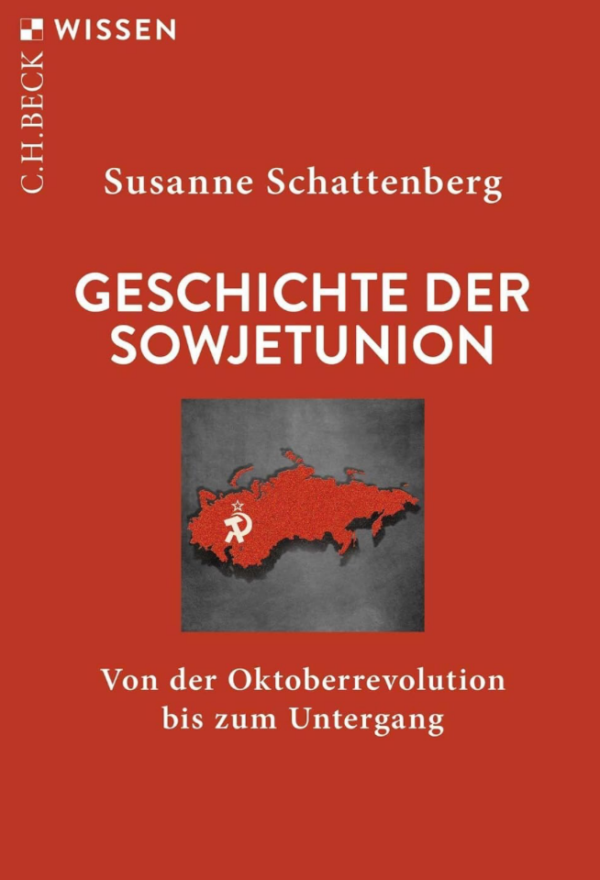 Geschichte der Sowjetunion. Von der Oktoberrevolution bis zum Untergang
After the revolutions of 1917 and a bloody civil war, the Soviet Union was founded on December 30, 1922. It dissolved on December 21, 1991. In between lay 69 years in which it left its mark on the world – through Stalinist terror, through its victory over the armies of Hitler’s Germany, as a nuclear power in the Cold War and with Gorbachev’s policy of détente. Its legacy still weighs heavily on the post-Soviet space today. Internally, under Stalin, it brought famine, deportations, the Gulag and arbitrary executions. But at the same time, the country underwent a fundamental modernization and the first man in space was a Soviet man. Susanne Schattenberg traces the years under the Soviet star and shows how they still have an impact today.
-
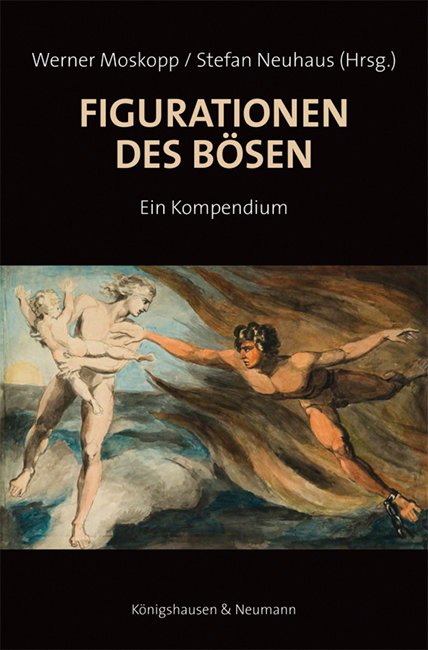 Hagen von Tronje: Vom Antagonist zum Bösewicht zum Antiheld. Überlegungen zur diachronen Entwicklung und Rezeption einer Antagonistenfigur
In Moskopp, Werner & Stefan Neuhaus (Hrsg.), Figurationen des Bösen. Ein Kompendium, 185-198. Würzburg: Königshausen & Neumann.
-
 Introduction. Namwali Serpell’s The Old Drift: Disruption
Research in African Literatures 53(3). 1-22. https://www.muse.jhu.edu/article/900030
-
 Namwali Serpell’s The Old Drift: Disruption (Special Issue)
Research in African Literatures, the premier journal of African literary studies worldwide, serves as a stimulating vehicle in English for research on the oral and written literatures of Africa. Reviews of current scholarly books are included in every number, and a forum offers readers the opportunity to respond to issues raised in articles and book reviews.
-
 State of the Planet. Homi Bhabha and Namwali Serpell in Conversation
After explaining the rationale for bringing the author of The Old Drift, Namwali Serpell, and critical theorist Homi Bhabha into conversation, this interview with both of them explores some of the key themes of Serpell’s novel in relation to its wider geopolitical and historical context. Beginning with how we can understand the state of the planet in the present historical moment, the discussion expands to explore the broad context of more themes in the novel, which includes the place of gender and sexual politics, a global pandemic in a time of national and financial closures, cosmopolitanism, the space race and reverberations of the Cold War in the present, and the continued relevance, if any, of postcolonial theory, technology, revolution, and futurity.
-
 Agency and Incentives of Diasporic Political Influencers on Facebook Malawi
This article examines the agency and incentives that drive the activism of diasporic political influencers on “Facebook Malawi,” an online imagined political community. In their seminal work on “social media dissidents” and “social media self-made activists” in the Global South, Matsilele and Sharra demonstrate that social media activists engage with different strategies to initiate movements, mobilize citizens, and create their brands in strong opposition to authoritarian regimes which repositions them as freedom fighters in the eyes of the masses and enemies of the state. Correspondingly, we frame diasporic political influencers as actors aided by digital technologies who engage in “long-distance nationalism” on Facebook against authoritarianism in the homeland. We deploy a qualitative mixed methods approach to analyze Facebook data of two diasporic political influencers, Onjezani Kenani and Manes Winnie Hale, who gave informed consent to use their Facebook data generated in 2018 and 2021, a period preceding and following the 2019 Malawi tripartite elections. A thematic analysis of 250 Facebook posts and interview data with the two influencers illustrates how they exercise their agency in their quest for a vision of a better Malawi while navigating a complex and ambivalent web of online and offline threats, incentives, and interests. Implicated in the political communication and mobilization of the two are different strategies that include verbal inventiveness, trolling, and exposing. The article also shows how the concept of long-distance nationalism needs to be adapted in studying diasporic political influencers.
-
 Politischer Diskurs und Hegemonie. Das Projekt »Soziale Marktwirtschaft«
How do dominant political language and thought patterns emerge and how are they related to social power relations? This volume aims to get to the bottom of these questions about the functioning of discursive hegemonies by linking political science and discourse studies. The political-discursive characteristics and strategies of successful hegemonies are reconstructed on the basis of an examination of the hegemonic project “social market economy”. In addition, the exemplary analysis of the West German economic policy discourse of the post-war years illustrates how political science can benefit from discourse studies research.
-
 Politische Ideengeschichte und politische Hegemonie. Anmerkungen zum ‚Battle of the Books‘ an den amerikanischen Colleges
In Bluhm, Harald & Jürgen Gebhardt (eds.) Politische Ideengeschichte im 20. Jahrhundert, 223–242. Baden-Baden: Nomos. ISBN: 978-3-8329-2181-1
-
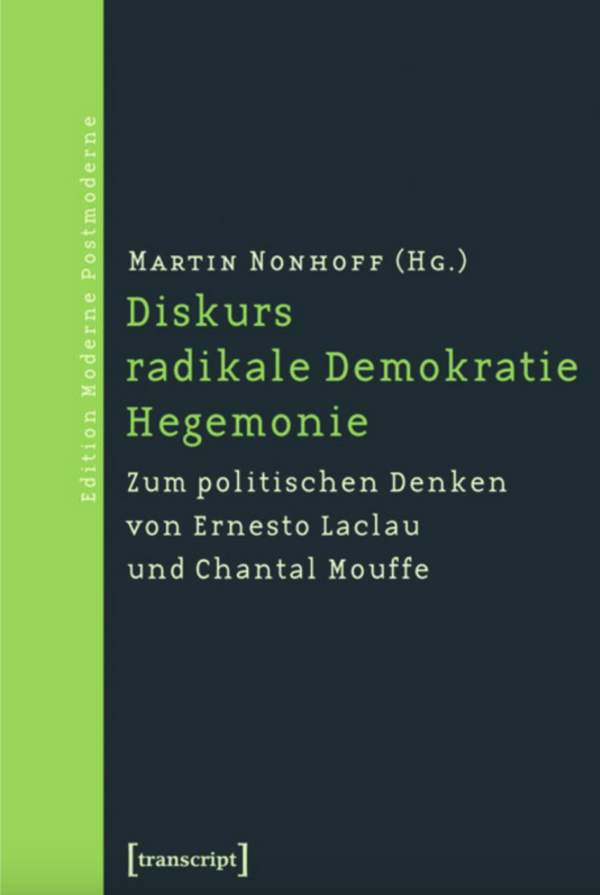 Diskurs – radikale Demokratie – Hegemonie.
Few political thinkers have influenced the international political and social science theory discourse of recent years as much as Chantal Mouffe and Ernesto Laclau – across paradigm boundaries. Both combine neo-Gramscian, (post-)structuralist and psychoanalytical theoretical elements and thus enable an explanation of political-discursive events, in particular the formation of hegemonies, on the one hand, and a normative theory of agonal democracy on the other.
The contributions in this volume provide an overview of Laclau’s and Mouffe’s key figures of thought, critically examine them and point out methodological and empirical connections.
This volume contains original texts by Ernesto Laclau and Chantal Mouffe, among others.
-
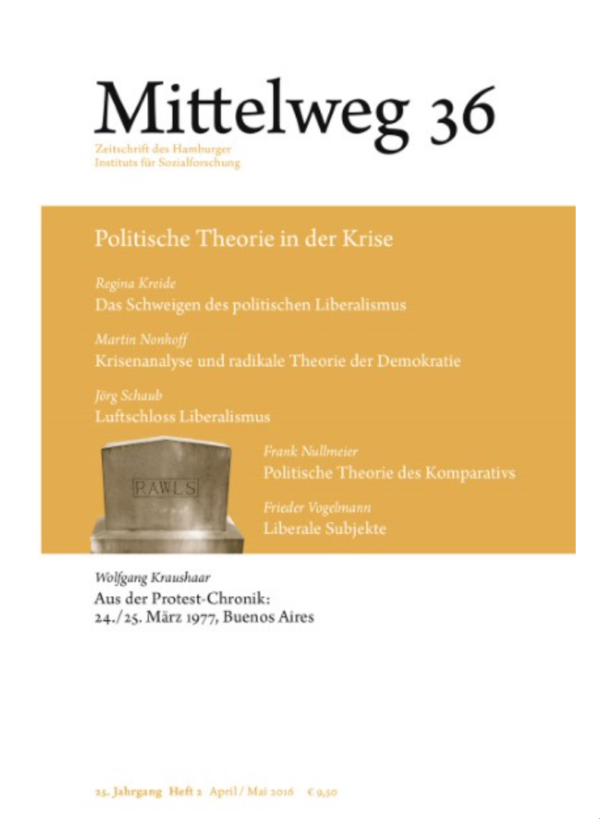 Politische Theorie in der Krise
Martin Nonhoff/Frieder Vogelmann: Editorial (Seite 3); Regina Kreide: Das Schweigen des politischen Liberalismus (Seite 5); Martin Nonhoff: Krisenanalyse und radikale Theorie der Demokratie (Seite 21); Jörg Schaub: Luftschloss Liberalismus. Warum das Denken in Krisenzeiten keinen Halt findet (Seite 38); Frank Nullmeier: Politische Theorie des Komparativs. Soziale Vergleiche und gerechte Gesellschaft (Seite 56); Frieder Vogelmann: Liberale Subjekte Eine affirmative Streitschrift (Seite 74); Wolfgang Kraushaar: Aus der Protest-Chronik: 24./25. März 1977, Buenos Aires (Seite 91)
-
 Krisenanalyse und radikale Theorie der Demokratie.
Mittelweg 36. Zeitschrift des Hamburger Instituts für Sozialforschung 2(2016) ISBN: 978-3-86854-736-8
-
Discourse Analysis as Critique
This paper intervenes in the discussion about the relationship between discourse analysis and critique. It argues that this relationship can be understood either as an external or as an integrated relationship. In an external relationship, there is first social criticism that is then braced by discourse analysis, that is, the latter aims at giving empirical credence to the critique. However, such an external relationship cannot give us any insight concerning the critical potential that is specific to discourse analysis, precisely because in this case critique exists before and independent of discourse analysis. If, however, critique emanates from discourse analysis itself, we would speak of an integrated relationship and would no longer speak of discourse analysis and critique, but of discourse analysis as critique. It is argued that such an integrated relationship becomes visible once we think of discourse analysis as being itself a discursive formation and ask what unsettling effects this formation has on research objects, on subject formations and on the academic production context in which they are conducted.
-
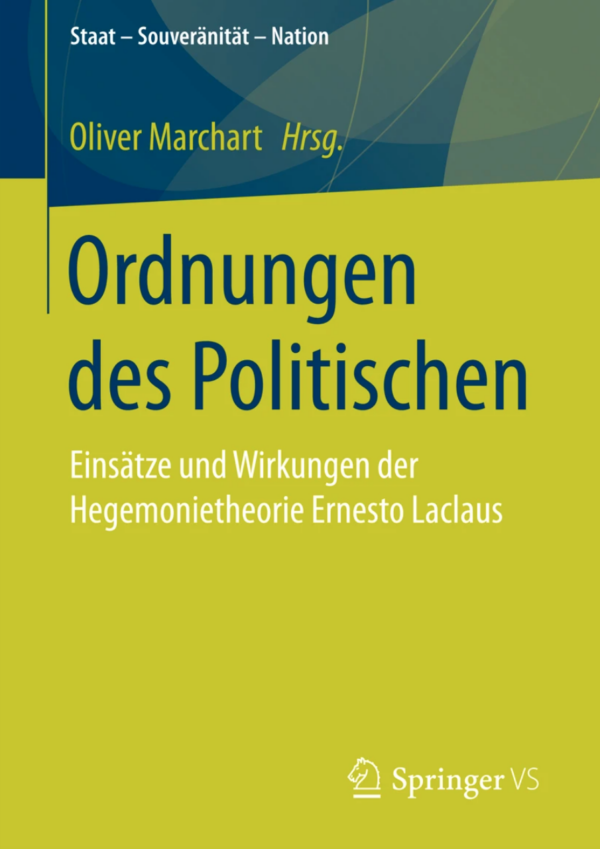 Antagonismus und Antagonismen. Hegemonietheoretische Aufklärung
In Oliver Marchart (eds.) Ordnungen des Politischen. Einsätze und Wirkungen der Hegemonietheorie Ernesto Laclaus, 81–102. Wiesbaden: Springer VS. printISBN: 978-3-6581-7258-9 ebook ISBN: 9783-6581-7259-6
-
 Das Politische und die Option auf Herrschaftskritik, oder: Populismus
In Flügel-Martinsen, Oliver, Franziska Martinsen & Martin Saar (eds.) Das Politische (in) der Politischen Theorie. Stuttgart: Nomos. printISBN: 978-3-8487-8414-1 ebook ISBN: 978-3-7489-2790-7
-
 Radikale Demokratietheorie als Gesellschaftstheorie
In Martin Nonhoff, Sebastian Haunss, Tanja Klenk, Tanja Pritzlaff-Scheele (eds.) Politik und Gesellschaft verstehen. Frank Nullmeier zum 65. Geburtstag. Frankfurt/Main: Campus, 49–64. printISBN: 9783593516660 eBookISBN: 9783593453088
-
 Colonial Flashback im Museum – Was Missionsobjekte über kirchliche Erinnerungskultur erzählen
Mission collections throughout Germany represent the material and ideological colonial legacy of the churches. Franziska Moosmann shares her impressions of her analysis of a mission museum exhibition and invites readers on a tour of selected rooms. In doing so, she asks how postcolonial theology and the culture of remembrance can be challenged and transformed by the objects on display.
-
 Marginalisierung in der Marginalität? Ein Blick auf digitale Räume anhand sprachlicher Konstruktion von randständigen Positionen im Kontext von Asexualität
This article discusses marginalisation in internet forums and blogging platforms using the example of asexuality blogs and discussion threads. While large corpora of both English and German, such as COCA and DeReKo, contain hardly any mention of asexuality and these few instances of asexuality and related expressions typically refer to plant biology, online communities do discuss aspects of life as an asexual person and their experiences of marginalization even within the LGBTQ community. Definitions of asexuality, including its delineation from other identities, and how asexual people articulate conflicts and other issues on these online platforms are discussed in detail. Particular attention is paid to how this particular group is constructed by others, how they construct themselves as not being part of the mainstream, and the role (self-)marginalisation plays in this context.
-
 Digitale Räume als Aushandlungsort für Zentralität und Marginalität
In Auteri, Laura, Natascia Barrale, Arianna di Bella & Sabine Hoffmann (eds.) Jahrbuch für internationale Germanistik. Wege der Germanistik in transkultureller Perspektive. Akten des XIV. Kongresses der Internationalen Vereinigung für Germanistik (IVG) 6: 511-515. Bern: Peter Lang Verlag.
-
 Gänsehaut, Liebe und Langeweile. Sprachliche Konstitution von Emotionen in Laienbuchrezensionen aus dem Schullektürekanon
In Meier, Christel, Carolin Führer, Marco Magirius & Silke Kubik (eds.) Evaluative ästhetische Rezeption als Grundlage literarischen Verstehens und Lernens: Theorie und Empirie (KREAplus Band 28) 243–256. Muenchen: kopaed. ISBN: 978-3-96848-095-4